
How to Verify Third-Party Lab Results: A Step-by-Step Guide
Table of Contents
- What You'll Need Before You Start
- Step 1: Obtain the Certificate of Analysis (COA)
- Step 2: How to Read a COA and Identify Key Data
- Step 3: Verify Lab Accreditation and ISO 17025 Status
- Step 4: Check for Red Flags and How to Spot Fake Lab Reports
- Step 5: Compare In-House vs. Third-Party Testing
- Common Mistakes to Avoid When Verifying Lab Results
- Frequently Asked Questions
Last Updated: September 19, 2026
What You'll Need Before You Start
Gather the Certificate of Analysis (COA), product packaging, internet access, and the manufacturer's website. These essentials let you verify third-party lab results, batch numbers, accreditation status, and compare claims against actual test results.
Step 1: Obtain the Certificate of Analysis (COA)
Obtain the COA from the manufacturer's website (search for "Lab Results" or "Certificates"), via email request, or through a QR code on the packaging.
Step 2: How to Read a COA and Identify Key Data
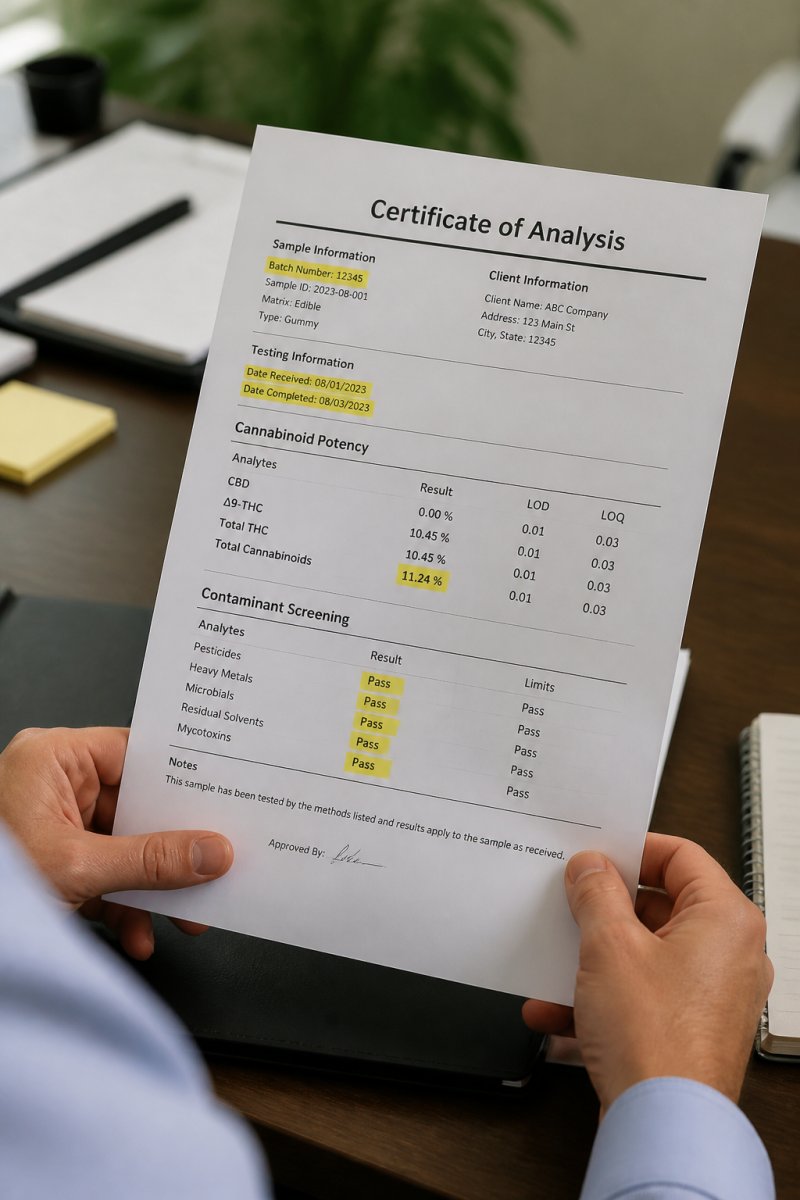
A COA contains the lab's name, testing dates, product details, and numerical results for potency and contaminants.
Batch and Lot Numbers
Match the batch number on your product packaging to the COA exactly. A mismatch means the results don't apply to your product, since different batches may have different potency or purity levels.
Testing Dates and Chain of Custody
Check the "Date Received" and "Date Tested" fields for freshness. Verify chain of custody fields ("Received by," "Tested by," "Approved by") are filled in; blank fields indicate weak documentation.
Potency, Contaminant, and Purity Results
The results section shows potency (concentration of active compounds), contaminants (heavy metals, pathogens, pesticides), and purity. Look for specific values with units and acceptance criteria; results outside the acceptable range indicate a failed test.
Step 3: Verify Lab Accreditation and ISO 17025 Status
ISO 17025 accreditation proves a lab meets rigorous standards and undergoes independent audits (About ILAC International Laboratory Accreditation Cooperation). However, labs may be accredited for some tests but not others, so verify the accreditation scope matches the tests on your COA.
How to Find and Verify Lab Accreditation
Locate the accreditation statement on the COA and note the accreditation body name (e.g., A2LA, ACLASS, state health department, or ILAC member). Verify the body is recognized; fraudulent labs claim accreditation from fake bodies.
Understanding Accreditation Scope
A lab may be accredited for some tests but not others. In the accreditation database, find the "Scope of Accreditation" field and verify every test on your COA is listed. For example, if the scope covers only potency and heavy metals, microbial results are not accredited.
Verifying Accreditation Currency and Validity
Verify the accreditation is "current" or "active" in the database and check the expiration date. If expired, COAs issued after that date are not accredited. Recent audits (within 12 months) indicate active oversight.
What to Do If a Lab Lacks ISO 17025 Accreditation
If a COA comes from a non-accredited lab, check for alternative industry-specific certifications, verify the lab's reputation online, ask the manufacturer about quality assurance practices, or request retesting by an accredited lab.
Matching Accreditation to Your Needs
Different tests require different accreditation: potency (widely accredited), microbial (specialized), heavy metals (common), pesticide residues (less common), and allergen testing (specialized). Confirm the lab's scope covers your product's required tests.
Red Flags in Accreditation Claims
Red flags: vague accreditation statements without a named body, accreditors with no online presence, labs not in the accreditation database, tests outside the lab's scope, or expired accreditation.
Summary: The Accreditation Verification Workflow
- Note the accreditation body name from the COA.
- Visit the accreditor's website and search for the lab by name.
- Confirm the lab appears in the active/current accreditation list.
- Review the lab's scope of accreditation and confirm all tests on your COA are included.
- Check the accreditation expiration date to ensure it's current.
- If anything is missing or unclear, contact the lab directly to request accreditation documentation.
Accreditation verification takes 10-15 minutes but provides concrete proof that the lab meets recognized standards and that the testing was performed under rigorous quality controls.
Step 4: Check for Red Flags and How to Spot Fake Lab Reports
Scammers create fake or altered COAs to hide failed tests, inflate potency, or misrepresent batch numbers. Use a systematic forensic checklist to spot these red flags.
The COA Forensics Checklist
Run the COA through these checks: (1) Document integrity, consistent fonts, legible signatures, full lab contact info, original quality; (2) Data consistency, matching batch numbers across sections, logical date sequences, methodology matching results; (3) Result plausibility, varied decimal places, trace contaminants present, acceptance criteria stated, failed tests documented.
Visual Red Flags: What Fake Reports Look Like
Formatting and Design Red Flags:
- Misaligned text blocks or tables that don't line up vertically
- Multiple font sizes or styles used inconsistently (e.g., headers in one font, body text in another)
- Low-resolution or pixelated lab logos, watermarks, or seals
- Inconsistent spacing between sections or uneven margins
- Spelling errors or grammatical mistakes on an official document (labs proofread these carefully)
Content Red Flags:
- Lab name on the COA doesn't match the lab name in the accreditation database
- Testing methodology is vague or missing (e.g., "tested for potency" instead of "HPLC analysis per USP <921>")
- No reference standards or control samples mentioned
- Results lack units of measurement (e.g., "potency: 20" instead of "potency: 20%")
- Acceptance criteria are missing or stated as "meets manufacturer specifications" without defining what that means
Digital Verification and QR Code Validation
Many accredited labs now embed digital verification into COAs through QR codes or unique batch codes. This is one of the strongest authenticity checks available.
How to use digital verification:
- Locate the QR code or batch verification code on the COA (usually in the header or footer).
- Scan the QR code with your phone camera or a QR code reader app, or visit the lab's verification portal and enter the batch code manually.
- Compare the digital results to the printed COA. They should match exactly, same batch number, same test dates, same potency and contaminant values.
- If the digital results differ from the printed document, the printed version has been altered.
- If the QR code doesn't work, leads to an error page, or returns a "batch not found" message, the COA is likely fabricated.
Common Alteration Techniques and How to Spot Them
Photoshop and Image Editing Signs:
- Uneven color saturation or brightness in different sections (suggests copy-paste from multiple sources)
- Halos or soft edges around text or logos (indicates layer blending)
- Inconsistent shadow or reflection effects
- Watermarks that appear faded in some areas but sharp in others
Copy-Paste Alterations:
- Batch numbers that look slightly different in font or size from the rest of the document
- Potency or contaminant values that appear to be overlaid on top of original numbers
- Signature blocks that don't align with the rest of the document
Template Fraud:
- The COA uses a generic template with placeholder text still visible (e.g., "[LAB NAME HERE]" or "[ANALYST SIGNATURE]")
- Multiple COAs from the same manufacturer use identical layouts and formatting, including identical decimal places across different batches (real variation should exist)
What a Legitimate COA Looks Like
A real COA from an accredited lab includes:
- Professional, consistent formatting with clear section headers
- Lab name, address, phone, and email prominently displayed
- Analyst name and signature (or digital approval code) with a date
- Batch number, lot number, and sample ID that match your product
- Testing dates (received and tested) that are recent and in logical sequence
- Detailed methodology for each test (e.g., "HPLC per USP <921>" or "ICP-MS per EPA Method 6020B")
- Numerical results with units and acceptance criteria clearly stated
- A mix of results, some high, some low, some at trace levels, showing realistic variation
- A statement of accreditation (e.g., "ISO 17025 accredited by [Accreditation Body Name]")
- A QR code or batch verification code that links to a working digital verification system
- Any failed tests clearly marked and explained Comprehensive documentation serves as the primary defense against adulteration, yet rigorous scrutiny remains essential when checking purity levels to ensure the chemical integrity of your specific compounds.
When to Request a New COA
If a COA fails any of the forensic checks above, request a new one directly from the manufacturer or lab. Legitimate companies will:
- Provide the COA within 24-48 hours
- Offer digital verification if available
- Explain any unusual results or failed tests
- Provide contact information for the lab so you can verify independently
If a company refuses to provide a new COA, cannot explain discrepancies, or becomes defensive, that is a strong signal the product's testing is not legitimate.
Step 5: Compare In-House vs. Third-Party Testing
Understanding the difference between in-house and third-party testing helps you assess the credibility of lab results. In-house testing means the manufacturer tested their own product using their own lab. Third-party testing means an independent lab tested the product.
Common Mistakes to Avoid When Verifying Lab Results
Many people skip steps when verifying lab results, which leaves them vulnerable to fake or misleading documents. The most common mistake is not checking the batch number. You might have a legitimate COA, but if it doesn't match your product's batch, the results don't apply to what you own.
Frequently Asked Questions
What is a Certificate of Analysis (COA) and why do I need it?
A Certificate of Analysis is an official document from an independent laboratory that documents the results of product testing. It verifies potency, checks for contaminants like heavy metals and microbial pathogens, and confirms the product matches what's on the label. For THC products, a COA proves your edible has been tested by a third-party lab and meets safety and quality standards. Without it, you have no independent verification that the product is safe or accurately labeled.
How do I verify that a lab is ISO 17025 accredited?
ISO 17025 accreditation means a lab meets strict international standards for competence and impartiality. To verify a lab's ISO 17025 status, visit the A2LA (American Association for Laboratory Accreditation) website or contact the lab directly and ask for their accreditation certificate. You can also request their scope of accreditation, which lists exactly which tests they're certified to perform. Never assume a lab is accredited just because it claims to be, always verify independently.
What are the biggest red flags that a lab report might be fake or altered?
Red flags include missing or mismatched batch numbers between the product and the report, test dates that don't align with when the product was made, incomplete testing (missing potency or contaminant panels), unprofessional formatting, and results that seem too perfect (all tests passing at exactly acceptable limits). Also watch for missing lab contact information, no chain of custody documentation, or a lab that can't be verified as legitimate. If something looks off or the numbers seem suspicious, contact the company directly and ask for verification.
Is third-party testing enough, or should I also look for in-house testing?
Third-party testing is the gold standard because an independent lab has no incentive to falsify results. In-house testing alone isn't reliable because manufacturers can manipulate their own results. The best scenario is a product that has both third-party verification and in-house quality assurance, third-party testing proves safety and potency, while in-house testing shows the company cares about consistency. Always prioritize third-party results over in-house claims alone.
Verifying third-party lab results is essential when choosing any product you consume. At ZUUZ, we understand that transparency builds trust. Every batch of our THC gummies and sugar-free tarts undergoes rigorous third-party testing with full COA documentation available on our website. Our nanotech extraction method delivers consistent, reliable effects, and our lab results prove it. With our 60-day money-back guarantee, you can verify the quality yourself risk-free.