
Why Lab Testing Matters for Edibles
Table of Contents
- Why Lab Testing Matters for Edibles
- What Third-Party Lab Testing Reveals
- Common Contaminants in Unregulated Edibles
- THC Potency Testing Standards and Accuracy
- How to Read a Cannabis Certificate of Analysis
- Homogeneity Testing: Ensuring Consistent Dosing
- What Tested Edibles Mean for Your Safety
- Frequently Asked Questions
Last Updated: September 24, 2026
Why Lab Testing Matters for Edibles
Lab testing edibles means submitting cannabis-infused products to independent third-party laboratories for analysis of potency, contaminants, and safety. Untested edibles leave you guessing about THC accuracy, pesticide residues, and microbial contamination. Because edibles are consumed orally, contaminants bypass your lungs' natural filtration and enter your digestive system directly.
At ZUUZ, we understand that consistent, reliable effects depend entirely on knowing what's actually in the product. That's why every ZUUZ edible is third-party lab tested and formulated with our nanotech extraction method to deliver predictable results without the anxiety or harsh comedowns many users experience. The difference between a tested and untested edible isn't subtle, it's the difference between a product you can trust and a product that's essentially an experiment.
Edibles carry higher stakes than other cannabis products. Because they take 30-120 minutes to kick in and last 4-8 hours, users can't adjust mid-experience like with smoking or vaping. An untested edible could hit twice as hard as advertised or be underdosed entirely. Lab testing eliminates this uncertainty.
What Third-Party Lab Testing Reveals
Third-party lab testing reveals an edible's composition and safety profile: cannabinoid potency (THC and CBD), contaminants (pesticides, heavy metals, residual solvents), microbial analysis, and terpene profiles. This data appears on a Certificate of Analysis (COA), your proof of independent verification.
The "third-party" part is critical. In-house manufacturer testing has incentive bias; independent labs have no such bias and their reputation depends on honest reporting.
A proper COA includes batch-specific information, testing date, lab accreditation status, and measurements for each cannabinoid and contaminant. Comprehensive testing screens for 50+ compounds; limited testing covers fewer. More comprehensive testing increases confidence in product safety.
Common Contaminants in Unregulated Edibles
Unregulated edibles frequently contain pesticide residues, heavy metals, and microbial contaminants. Pesticides like myclobutanil convert to hydrogen cyanide when heated and pose health risks. Heavy metals like lead and cadmium accumulate in the body over time.
Microbial contaminants like E. coli and Aspergillus are particularly concerning in edibles because the food matrix provides an ideal growing environment. Untested products may harbor dangerous microbes that lab testing would flag.
Residual solvents from extraction (butane, hexane) can linger if not properly purged. These solvents are neurotoxic and should never be present. Lab testing screens for residual solvents and enforces maximum allowable limits.
THC Potency Testing Standards and Accuracy
THC potency testing measures the exact amount of THC in a product. A 5mg THC product should contain approximately 5mg per serving with minimal variance, ensuring predictable and repeatable dosing.
How Potency Testing Works
Labs use HPLC (high-performance liquid chromatography) or GC-MS (gas chromatography-mass spectrometry). HPLC measures raw (THCA) and activated (THC) forms; GC-MS uses heat to convert THCA to THC. Both are valid but may produce slightly different results. A well-run lab has a 10-15% margin of error; a 5mg edible might test at 4.5-5.75mg. Untested edibles could range from 2mg to 10mg with no way to know.
Testing begins with sample preparation: the lab receives a few pieces and homogenizes them into uniform consistency. If the sample isn't uniform, results won't reflect the actual product. The lab then extracts cannabinoids, measures concentration, and calculates potency per serving.
Homogeneity Testing: The Hidden Challenge
Homogeneity testing verifies that each individual piece contains roughly the same THC amount, while potency testing measures only the average. This distinction is critical and often misunderstood.
A batch of 100 gummies labeled 5mg might average 5mg overall, but individual pieces could range from 2mg to 8mg if manufacturing wasn't carefully controlled. This inconsistency is dangerous for new users and frustrating for experienced ones.
Homogeneity testing analyzes 3-10 individual pieces separately to confirm each falls within an acceptable range, typically 10-15% of the target dose. For a 5mg target, all pieces should fall between 4.25mg and 5.75mg. Wide variance indicates poor manufacturing control.
Why Homogeneity Matters for Edibles Specifically
Edibles are pre-portioned; you consume the entire piece and get whatever THC is in it. This makes homogeneity a safety and efficacy issue. A first-time user expecting 5mg but getting 8mg might panic; regular users expecting consistent effects get unpredictable experiences without homogeneity control.
Poorly mixed cannabis extract creates hot spots (high THC) and cold spots (low THC) because extract is sticky and doesn't distribute evenly. Advanced techniques like nanotech extraction break cannabinoids into smaller particles that distribute more uniformly.
Homogeneity testing is labor-intensive and adds cost. Manufacturers committed to homogeneity must test multiple pieces per batch, which is why tested edibles cost more than untested ones.
Regulatory Variation in Potency Testing Standards
Potency testing standards vary between state-regulated and unregulated markets. In regulated states like California, Colorado, and Massachusetts, testing is mandatory with state-specific standards. California requires ISO 17025 accreditation and testing for both THCA and THC, with a typical 10-15% margin of error.
In the unregulated hemp-derived market, testing is voluntary with no federal mandate or standardized protocols. Some manufacturers test through reputable labs; others make unverified claims. This creates a two-tier market: regulated products with verified potency and unregulated products with often-unverified claims.
Even within regulated markets, standards differ. Some states require homogeneity testing; others don't. Some mandate 40+ pesticide tests; others require only 20. A product made in California has undergone more rigorous testing than an identical product from an unregulated market.
What Acceptable Potency Variance Looks Like
Some variance is normal: a 5mg edible testing at 4.8-5.2mg is acceptable; 4.5-5.5mg is reasonable. But 3.5-6.5mg suggests quality control issues, and 2-8mg is a serious red flag indicating mislabeling or poor manufacturing.
For homogeneity data, look for consistency across tested pieces. Results of 4.9-5.05mg indicate excellent homogeneity; results of 3.5-6.8mg indicate poor homogeneity and improper manufacturing.
The bottom line: potency testing tells you the average THC content; homogeneity testing tells you whether each piece is consistent. Both matter, but homogeneity is often overlooked despite being the more practical concern for consumers who consume individual pieces of an edible.
How to Read a Cannabis Certificate of Analysis
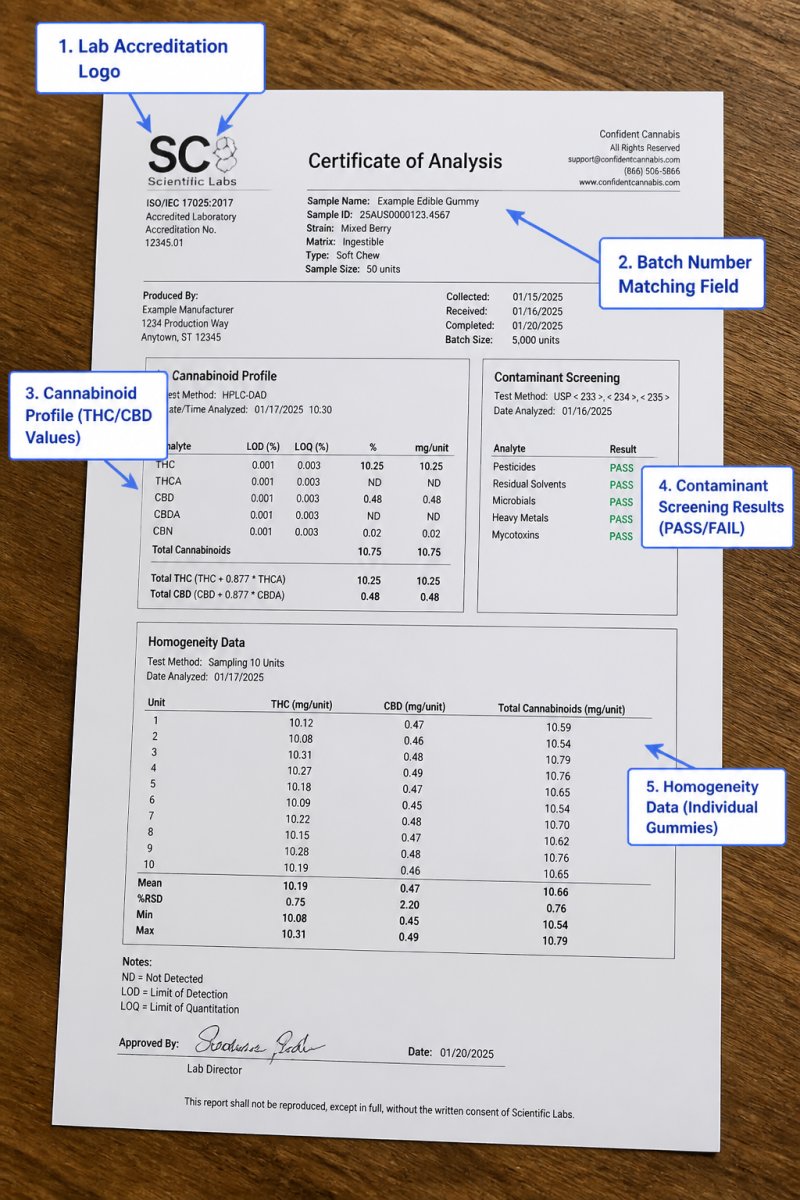
A Certificate of Analysis is your direct line to the truth about what's in an edible, but only if you know what to look for. Most consumers receive a COA and have no idea how to interpret it. Here's a field-by-field breakdown of what matters.
Lab Accreditation and Identity
Verify the lab's name and ISO 17025 accreditation, the gold standard for testing labs in North America. In regulated markets, confirm state-specific licensing. The COA should list lab contact information and analysis date. If unfamiliar, search online, reputable labs maintain public accreditation records.
Batch Number and Product Matching
Verify the batch number on your product matches the COA. A COA is batch-specific; mismatched numbers mean results don't apply to your product. Testing dates should be recent, within 6 months for shelf-stable edibles.
Cannabinoid Profile: The Potency Section
Locate the cannabinoid analysis section listing THC, CBD, and other cannabinoids. For a 5mg THC edible, results should show approximately 5mg per serving within a 10-15% margin of error. If the label says 5mg but the COA shows 2mg or 8mg, that's a red flag.
Watch for labs reporting only THCA without THC equivalency conversion. Raw THCA is not psychoactive until heated. Reputable labs report both raw cannabinoid content and "total THC."
Contaminant Screening: Pesticides, Heavy Metals, and Microbial
The contaminant section shows results for pesticides, heavy metals, microbial contaminants, and residual solvents: "PASS," "FAIL," or "BELOW LIMIT OF DETECTION" (BLD). Any "FAIL" or state-limit exceedance is disqualifying.
For pesticides, comprehensive testing screens for 30-50+ residues. If a COA lists only 5-10 pesticides, it's less thorough. All tested pesticides should show "PASS" or "BLD."
Heavy metals (lead, cadmium, arsenic, mercury) accumulate in the body over time. The COA should show specific concentration levels and confirm they fall below state limits. For example, California's lead limit is 0.5 micrograms per gram.
Microbial testing screens for pathogens like E. coli, Salmonella, Listeria, and Aspergillus. These are critical for edibles because the food matrix provides an ideal growing environment. A COA should show "PASS" for all microbial categories.
Residual solvents (butane, hexane, ethanol) should be at zero or below detection limits. All solvents should show "PASS" or "BLD."
Homogeneity Data (If Provided)
Homogeneity data shows multiple pieces tested individually for consistent THC levels. All pieces should fall within 10-15% of the target dose.
Terpene Profile (Optional but Informative)
Red Flags to Watch For
Homogeneity Testing: Ensuring Consistent Dosing
Homogeneity is where nanotech extraction methods like those used in ZUUZ products make a real difference. By breaking down the cannabinoids into smaller particles, nanotech extraction allows for more uniform distribution throughout the edible matrix. This means each gummy or tart contains a consistent dose, so you get the same reliable experience every time you consume one.
What Tested Edibles Mean for Your Safety
When an edible has passed third-party lab testing, you're getting multiple layers of assurance. First, you know the dosing is accurate, what the label says is what you're getting. Second, you know the product is free from pesticides, heavy metals, and microbial contaminants that could harm you. Third, you know the product was manufactured under conditions where quality control was a priority.
Frequently Asked Questions
What is a Certificate of Analysis (COA) for edibles?
A Certificate of Analysis is an official lab report that documents the results of third-party testing on an edible product. It shows cannabinoid potency (THC and CBD levels), contaminant screening results, and other quality metrics. A legitimate COA includes the lab's accreditation, batch number, testing date, and specific measurements.
Why is potency testing important for THC gummies and edibles?
Potency testing ensures that the THC content matches what's labeled on the package. Without third-party verification, you can't know if a gummy labeled '5mg THC' actually contains 5mg or 15mg. Inconsistent dosing leads to unpredictable effects and increases the risk of overconsumption, especially for beginners. Lab-tested edibles deliver the consistent, reliable experience you expect, critical for users seeking stress relief or better sleep without harsh comedowns.
What contaminants should I look for on a lab test?
Third-party lab testing screens for pesticide residues, heavy metals (lead, cadmium, mercury), residual solvents, and microbial contaminants like E. coli and mold. A complete COA will show results for all these categories. Unregulated edibles often skip these tests entirely, putting consumers at risk. When reviewing a COA, confirm that all contaminant categories show 'pass' or results below regulatory limits, this is non-negotiable for safe consumption.
How does lab testing affect edible consistency and dosing accuracy?
Lab testing includes homogeneity testing, which verifies that THC is evenly distributed throughout the entire batch. Without homogeneity verification, some gummies in a package might contain 2mg THC while others contain 8mg. This inconsistency causes unpredictable effects. Third-party labs test multiple samples from different parts of the batch to confirm even distribution, ensuring that every gummy delivers the same experience. This is why tested edibles are more reliable for consistent results.