
How to Stretch at Your Desk to Relieve Work Stress
Quick Summary
Desk stretches for stress relief are short moves you can do in your chair, such as neck tilts, shoulder rolls, overhead reaches, and seated spinal twists. Holding each one for 15 to 30 seconds eases neck, shoulder, back and hip tension without leaving your desk. Pair them with a slow 4-in, 6-out breath.
- Neck tilts, shoulder rolls, and overhead reaches target the areas where most desk strain builds up.
- Hold each stretch for 15 to 30 seconds, stopping at a gentle pull rather than pain.
- Choose a 2-, 5- or 10-minute sequence depending on how much time your break allows.
- Set a reminder to move every 60 to 90 minutes, since short regular breaks work better than one long session.
- See a clinician if pain lasts more than a few weeks or spreads, numbs, or tingles down an arm or leg.
Table of Contents
- Why Desk Stress Shows Up in Your Body
- Desk Stretches for Neck and Shoulders
- Seated Stretches at Work for Lower Back and Hips
- Standing Desk Stretches and Movement Breaks
- A Timed Stretch Break for Short, Medium and Long Breaks
- Breathing and Adaptations for Every Desk Worker
- When to Stop Stretching and Get Help
- Frequently Asked Questions
Last Updated: October 29, 2026
Stress builds up in the body long before most people notice it. A long day at a keyboard tightens the neck, rounds the shoulders, and locks up the hips. This guide covers desk stretches for stress relief you can do without leaving your chair or changing clothes.
A systematic review in the research found that stretching exercises showed a significant effect as a stand-alone treatment for work-related musculoskeletal disorders in four trials Impact of Stretching Exercises on Work-Related Musculoskeletal Disorders systematic review. A Delphi study of stretching experts also set out practical recommendations for stretching protocols that improve flexibility and joint mobility Practical recommendations on stretching exercise: A Delphi study. Both point to the same idea: short, regular movement helps.
Why Desk Stress Shows Up in Your Body
Most of the strain sits in a few places:
- Neck: forward head posture from staring at a screen
- Shoulders: raised or rolled forward while typing
- Upper back: rounded from leaning toward a monitor
- Hips: tight from sitting for long stretches
Desk Stretches for Neck and Shoulders
The neck and shoulders hold the most tension for most desk workers. Start here. Mayo Clinic now publishes office-based stretching collections because prolonged sitting carries real health risks Mayo Clinic office stretching guidance. These moves take under two minutes.
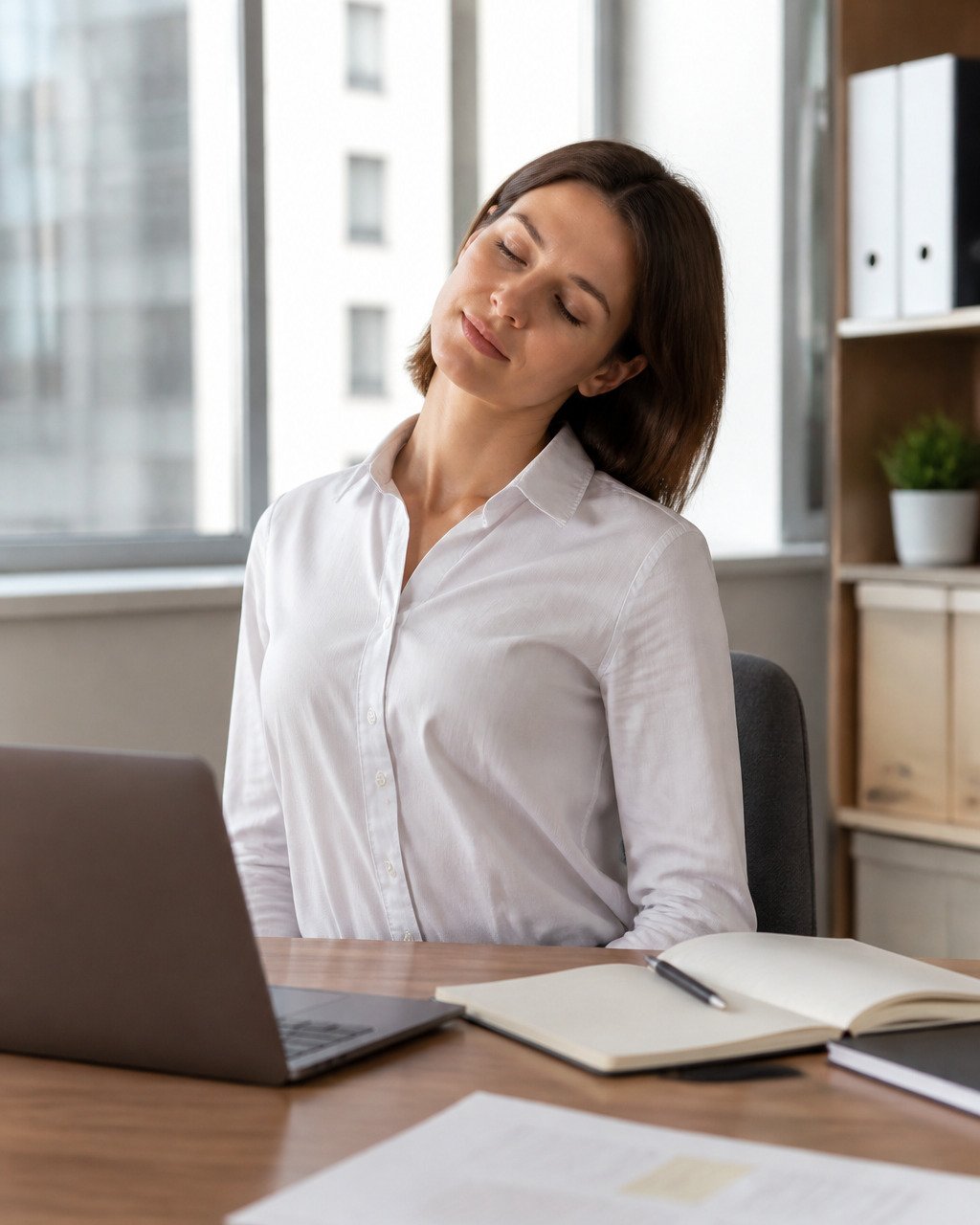
Neck Stretch and Shoulder Rolls
- Sit tall with your shoulders relaxed.
- Slowly tilt your right ear toward your right shoulder. Hold for 10 to 20 seconds.
- Repeat on the left side.
- Roll your shoulders backward in five slow circles, then forward in five.
Watch out: Move slowly. Never force the neck into a stretch or roll the head in a full circle.
Overhead Reach and Upper-Back Stretch
- Interlace your fingers and turn your palms up toward the ceiling.
- Reach overhead and hold for 15 to 30 seconds.
- Let your arms drop, then gently look over your right shoulder and hold for 15 seconds. Repeat on the left.
Hold each stretch long enough to feel a gentle pull, not pain.
Seated Stretches at Work for Lower Back and Hips
These seated moves need no equipment and no space.
- Seated side bend: Sit tall, reach your right arm over your head, and lean gently to the left. Hold for 15 seconds, then switch sides.
- Seated spinal twist: Place your right hand on the outside of your left thigh and gently rotate your upper body to the left. Hold for 15 seconds, then repeat on the other side.
- Seated hip stretch: Cross one ankle over the opposite knee and lean forward slightly from the hips. Hold for 15 to 30 seconds per side.
Repeat each side once. These moves pair well with a quick stand-up every hour.
Standing Desk Stretches and Movement Breaks
If you can stand, a few standing moves add variety. Research on stretching shows the body responds to changes in position, so mixing sitting and standing helps Practical recommendations on stretching exercise.
- Standing hip flexor stretch: Step one foot back, tuck the hips under, and hold for 15 to 30 seconds.
- Wall or desk push-off: Place your hands on your desk, step back, and lean into a gentle back stretch for 10 seconds.
- Quick walk: Walk to the water cooler or down a hallway for two to three minutes.
A Timed Stretch Break for Short, Medium and Long Breaks
A few rules apply to every sequence below:
- Move into each stretch slowly and stop at a gentle pull, not pain.
- Breathe in through your nose and out through your mouth; never hold your breath during a hold.
- Keep your shoulders down and your jaw loose.
- If a move feels sharp, numb, or tingly, skip it and try a seated alternative.
The 2-Minute Reset (short break)
Use this between meetings or when you only have a moment. Total time is about 2 minutes.
- Neck tilt, right side, 15 seconds.
- Neck tilt, left side, 15 seconds.
- Shoulder rolls backward, 5 slow circles, about 15 seconds.
- Shoulder rolls forward, 5 slow circles, about 15 seconds.
- Overhead reach, 20 seconds.
- Seated side bend, right, 15 seconds.
- Seated side bend, left, 15 seconds.
- Slow breathing, 3 breaths in a 4-in, 6-out pattern, about 30 seconds.
That is one round. If you have an extra minute, repeat the neck and shoulder portion once.
The 5-Minute Tension Release (medium break)
This is the sequence to use after a long block of focused work. Total time is about 5 minutes.
- Neck tilt, right and left, 15 seconds per side.
- Shoulder rolls, backward then forward, 5 circles each direction.
- Overhead reach, 20 seconds.
- Upper-back stretch (look over each shoulder), 15 seconds per side.
- Seated spinal twist, right and left, 15 seconds per side.
- Seated side bend, right and left, 15 seconds per side.
- Seated hip stretch (ankle over knee), right and left, 20 seconds per side.
- Slow breathing, 5 breaths in a 4-in, 6-out pattern.
Run the whole list once. If you finish early, spend the remaining time on the area that feels tightest.
The 10-Minute Full Reset (long break)
Use this at lunch or after a long meeting block. Total time is about 10 minutes, including a short walk.
- Neck tilt, right and left, 15 seconds per side.
- Shoulder rolls, backward then forward, 5 circles each direction.
- Overhead reach, 20 seconds.
- Upper-back stretch, 15 seconds per side.
- Seated spinal twist, 15 seconds per side.
- Seated side bend, 15 seconds per side.
- Seated hip stretch, 20 seconds per side.
- Standing hip flexor stretch, 20 seconds per side (if you can stand).
- Desk or wall push-off, 10 seconds, twice.
- Walk, 2 to 3 minutes at an easy pace.
- Slow breathing, 5 breaths in a 4-in, 6-out pattern to finish.
If you are working in a small space or cannot stand, replace steps 8 and 9 with a second round of the seated hip stretch and the seated spinal twist.
How to choose your break length
| Break length | Best for | Sequence |
|---|---|---|
| About 2 minutes | Between meetings, quick resets | 2-Minute Reset |
| About 5 minutes | After a focused work block | 5-Minute Tension Release |
| About 10 minutes | Lunch, after long meetings | 10-Minute Full Reset |
Breathing and Adaptations for Every Desk Worker
Try this before or after each stretch:
- Inhale through your nose for a count of four.
- Exhale slowly through your mouth for a count of six.
- Repeat three to five times.
Adaptations: If you have limited mobility, do the moves seated, shorten the hold time, or skip any move that causes pain. Chairs with armrests can support the shoulder rolls. Standing is optional for everyone.
When to Stop Stretching and Get Help
Stretching is a low-risk way to ease everyday desk tension, but it is not a treatment for an injury or a medical condition. Knowing the difference keeps you safe and sets realistic expectations.
Stop the stretch immediately if you feel:
- Sharp or stabbing pain, rather than a gentle pull.
- Numbness, tingling, or a pins-and-needles feeling in an arm, hand, leg, or foot.
- Dizziness, lightheadedness, or nausea.
- A headache that starts or worsens during a neck stretch.
- Pain that radiates down an arm or leg.
- Any stretch that feels worse the longer you hold it.
See a clinician if:
- Neck, shoulder, or back pain lasts more than a few weeks.
- Pain gets worse instead of better over time.
- Pain spreads down an arm or leg, or comes with weakness or clumsiness in a hand.
- You have a known medical condition, recent injury, or recent surgery affecting the neck, back, or joints.
- You are pregnant and unsure which stretches are appropriate.
What stretching can and cannot do
Stretching can temporarily ease the feeling of tightness, improve your sense of mobility, and give you a mental break from focused work. It is not a cure for chronic pain, a substitute for strength work, or a treatment for a diagnosed condition. Think of it as one small habit in a broader routine that includes movement breaks, a comfortable desk setup, and sleep.
Pair stretches with a better desk setup
- Monitor height: The top of the screen should be at or slightly below eye level so you are not craning your neck.
- Chair support: Adjust the seat so your feet rest flat on the floor and your lower back is supported.
- Keyboard and mouse: Keep them close enough that your elbows stay near your sides and your wrists stay neutral.
- Movement frequency: Stand or change position at least once an hour, even if only for a few seconds.
Adaptations for limited mobility or small spaces
You do not need to stand or have a large office to use this routine. Do the seated versions of each move, shorten holds to 10 seconds, and skip anything that does not feel comfortable. A chair with armrests can support shoulder rolls, and a wall or desk edge can substitute for open floor space.
Frequently Asked Questions
What are the best desk stretches for stress relief?
Desk stretches can include slow neck tilts, shoulder rolls, seated spinal twists and an overhead reach. Repeat on each side where the movement is one-sided.
How often should I take a stretch break at work?
A brief stretch break can include a few neck, shoulder and back moves. If a full break is not possible, you can do seated moves at your desk.
How long should I hold a desk stretch?
A good starting point is to hold most desk stretches for 10 to 20 seconds, or 15 to 30 seconds for larger muscle groups such as the hips and upper back. Hold the position steadily, breathe slowly, and ease off if you feel pain rather than a gentle pull. Holding longer does not automatically help more, so consistent, comfortable holds are the goal.
Can stretching at your desk help reduce stress?
Stretching at your desk can ease the physical tension that often accompanies stress, such as tight neck and shoulder muscles and a rounded posture. Combining stretches with slow, deep breathing can also help you feel calmer and more focused. These benefits are generally short-term, so desk stretches work best as one part of a broader approach to managing workplace stress, alongside regular movement, rest and good sleep.
Desk stress rarely goes away on its own. A few minutes of movement each hour, paired with slow breathing, can make a real difference by the end of the week. Start with the neck stretch and shoulder rolls today, and build from there.