
Does THC Help With Insomnia Symptoms? A 2026 Guide
Table of Contents
- Does THC Help With Insomnia Symptoms? What the Research Shows
- THC vs. Melatonin for Sleep: How They Compare
- THC Edible Onset and Duration: Timing Your Dose
- Risks of Using THC for Sleep: What to Know Before You Try It
- Cannabis Tolerance and Sleep: Why Effects Fade Over Time
- Beyond Falling Asleep: What THC Does to Sleep Quality and Daytime Functioning
- Practical Safety Guidance and When to See a Doctor
- Frequently Asked Questions
Last Updated: October 7, 2026
Does THC Help With Insomnia Symptoms? What the Research Shows
The short answer: THC may help you fall asleep faster short term, but the evidence is thin, mixed, and far from a cure.
Insomnia is a sleep disorder defined by trouble falling asleep, staying asleep, or both, at least three nights a week for three months or more.
Most guides get this wrong: they treat THC as a simple sleep switch. It is not.
National Center for Complementary and Integrative Health overview of cannabis and cannabinoids
Short-Term Effects on Sleep Onset
THC may shorten sleep onset latency, the time it takes to drift off, for some users. Preliminary research commonly finds people report falling asleep faster after cannabis, but the effect is modest and varies widely with dose, tolerance, and route. Some feel nothing; others feel too much.
Sleep Continuity and Nighttime Awakenings
Sleep continuity is where THC gets complicated. Some users report fewer nighttime awakenings; others wake more often as the high fades, staring at the ceiling at 3 a.m. The pattern is inconsistent and the study base too small to promise results.
THC vs. Melatonin for Sleep: How They Compare
THC and melatonin are not interchangeable. They act on different systems, carry different risk profiles, and rest on very different evidence.
Melatonin is a hormone your pineal gland releases in the evening to signal darkness.
THC works differently. It binds CB1 and CB2 receptors in the brain and nervous system, influencing mood, perception, pain signaling, and indirectly sleep.
| Feature | THC | Melatonin |
|---|---|---|
| Mechanism | Binds CB1/CB2 receptors; indirect effect on sleep | Shifts circadian timing via melatonin receptors |
| Best-supported use | Short-term sleep onset in specific populations | Jet lag, shift work, delayed sleep phase |
| Evidence quality | Preliminary; small trials, mixed results | Moderate for circadian issues; mixed for insomnia |
| Onset | Minutes (inhaled) to 30-90 minutes (edible) | 30-60 minutes |
| Duration | 4-8 hours (edible); shorter inhaled | Roughly 4-6 hours |
| Tolerance risk | Yes, with repeated use | Low |
| Dependence risk | Yes, in a subset of regular users | Low |
| Next-day grogginess | Possible, especially at higher edible doses | Uncommon at low doses |
| Key interaction concerns | Alcohol, sedatives, some antidepressants, anticoagulants | Few, but can interact with blood thinners and some medications |
How Strong Is the Evidence, Really?
Sort the evidence into three tiers, because headlines blur them together.
- Anecdotal reports. Forums and reviews are full of people who say cannabis helps them sleep. Useful for generating questions, not answering them, they cannot separate the drug's effect from placebo, expectation, or simply lying down relaxed.
- Preliminary and observational studies. Small trials and surveys suggest THC may shorten time to fall asleep, but samples are tiny, dosing inconsistent, and results rarely replicated. A common pattern: modest benefit that fades with continued use.
- Controlled trials. Large randomized placebo-controlled trials of THC for chronic insomnia are scarce. Most controlled data comes from other conditions, chronic pain, MS, chemotherapy nausea, where sleep was secondary. What helps sleep in a pain population may not generalize to anxiety-driven or schedule-driven insomnia.
Most practitioners treat this evidence base as suggestive but not definitive. That is why no major sleep or medical organization recommends THC as a first-line treatment for insomnia.
Practical Differences That Matter
A few practical points separate them:
- Dependence and withdrawal. Melatonin is not considered habit-forming for most. THC carries real risk of tolerance, dependence, and withdrawal-related rebound insomnia in regular users.
- Impairment. Melatonin does not impair driving or coordination at typical doses. THC does, and impairment can outlast the subjective high, especially with edibles.
- Interactions. Melatonin has few interactions but can affect blood thinners and some medications. THC interacts with alcohol, benzodiazepines, opioids, and some antidepressants, amplifying sedation or impairment.
For occasional trouble tied to a schedule shift, melatonin is the gentler first try. For pain- or anxiety-driven sleep onset problems discussed with a clinician, a low-dose edible may be considered, short-term, not nightly. Neither fixes a genuine sleep disorder or replaces a doctor's advice.
THC Edible Onset and Duration: Timing Your Dose
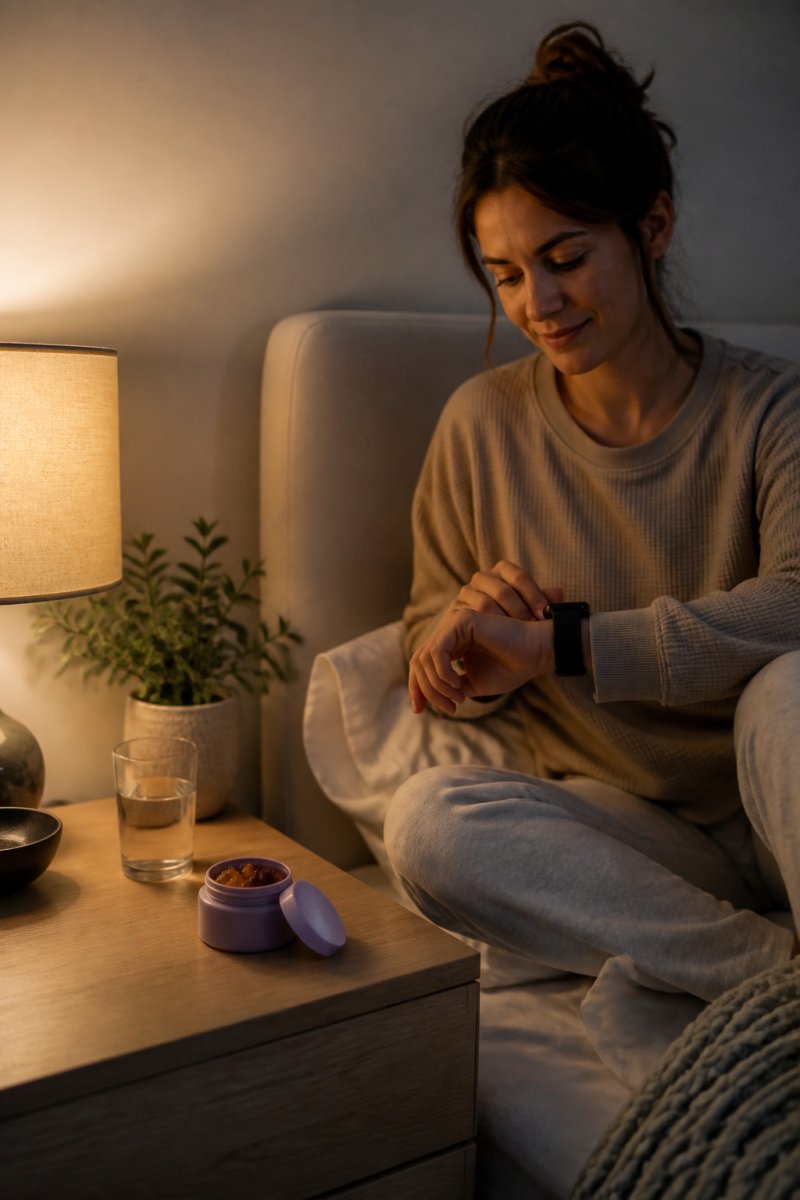
Edible onset, the lag between eating a THC product and feeling effects, typically runs 30 to 90 minutes, with effects lasting 4 to 8 hours.
Why Route and Timing Change the Experience
Route changes everything. Inhaled THC hits within minutes but fades faster; edibles start slower and last longer. For sleep, many prefer edibles because the effect carries through the night, the trade-off is slower onset and a higher chance of overshooting the dose.
Risks of Using THC for Sleep: What to Know Before You Try It
The risks are real. Regular use can lead to tolerance, dependence, and withdrawal symptoms like irritability and rebound insomnia when you stop. Some users get anxiety or a racing heart instead of calm. Anyone with a history of psychosis, heart conditions, or who is pregnant should talk to a doctor first.
REM Sleep, Sleep Architecture, and Next-Day Cognition
THC can suppress REM sleep, the stage tied to memory and emotional processing, potentially worsening next-day focus and mood. Sleep architecture can shift with regular use: you may sleep longer but wake less restored.
Cannabis Tolerance and Sleep: Why Effects Fade Over Time
Tolerance is one of the most consistent findings in the cannabis-and-sleep literature, and the main reason THC is a poor long-term strategy for most people. Understanding how it develops, and what happens when you stop, sets realistic expectations.
What Tolerance Actually Is
Tolerance means your body adapts to repeated exposure, so the same dose does less. With THC, two mechanisms drive it:
- Receptor downregulation. Chronic THC exposure can reduce the number and sensitivity of CB1 receptors, so the same dose does less.
- Metabolic tolerance. The liver becomes more efficient at clearing THC, so blood levels from a given dose fall faster.
For sleep, tolerance shows up as needing a higher dose for the same sleep-onset effect, or the effect vanishing after a few weeks of nightly use. Research commonly reports initial benefits, especially shorter time to fall asleep, diminishing with regular use.
How Fast Does It Develop?
Timelines vary by person, dose, and frequency, but general patterns hold:
- Occasional use (a few times a month) is less likely to produce noticeable tolerance.
- Nightly use can produce meaningful tolerance within a few weeks.
- Higher doses accelerate tolerance versus lower doses.
"Start low, go slow" matters, not just to avoid an uncomfortable high, but to preserve the effect over time.
Rebound Insomnia and Withdrawal
When regular users stop, the body readjusts. A well-documented pattern is rebound insomnia: sleep gets worse before it gets better.
Rebound insomnia typically peaks in the first few nights and eases over one to two weeks. For someone who started THC to sleep, this feels like a trap: the drug that helped you fall asleep is now why you cannot.
Dose, Route, and Timing: Why There Is No Universal Recommendation
There is no standard THC dose for sleep. Effects depend on:
- Dose. Lower doses may reduce anxiety and promote relaxation; higher doses can increase anxiety, heart rate, and racing thoughts, the opposite of bedtime calm.
- Route. Inhaled THC peaks in minutes and fades in one to three hours. Edibles peak at 30-90 minutes and last four to eight hours, often preferred for sleep, but with higher overshoot risk.
- Product composition. THC-to-CBD ratios vary widely, and CBD can modulate THC's effects. A mostly-CBD product behaves very differently from a high-THC edible.
Given that variability, start with the lowest measurable dose, wait a full two hours before more (longer for edibles), and track how you feel next morning, not just how fast you fell asleep.
Who Should Be Especially Cautious
Some groups face a higher risk-benefit tradeoff and should talk to a clinician first:
- Adolescents and young adults, whose brains are still developing and who face higher dependence and cognitive risks.
- Pregnant or breastfeeding individuals, for whom THC is generally advised against.
- People with a personal or family history of psychosis or bipolar disorder, since THC can trigger or worsen symptoms.
The Bottom Line on Long-Term Use
THC is not a durable solution for chronic insomnia. Tolerance erodes the benefit, withdrawal can worsen sleep when you stop, and long-term safety data is thin. Relying on it nightly for more than a few weeks is a signal to reassess with a clinician, not to increase the dose. For chronic insomnia, CBT-I remains first-line, evidence-based, and free of tolerance or withdrawal risks.
Beyond Falling Asleep: What THC Does to Sleep Quality and Daytime Functioning
Falling asleep is only one measure. Sleep quality, restorative sleep, and daytime functioning matter just as much. Some users feel rested; others feel foggy and flat next morning. Duration may increase while quality drops. If you wake tired after a full night, THC may not be your tool.
Practical Safety Guidance and When to See a Doctor
If you try THC for sleep, keep it simple and cautious:
- Start with a low dose and increase slowly
- Time your dose so effects fade before your alarm
- Track sleep onset, awakenings, and morning grogginess
See a doctor if insomnia lasts more than a few weeks, disrupts your daytime life, or comes with loud snoring or gasping. Cognitive behavioral therapy for insomnia is the first-line, evidence-based care for chronic insomnia. American Academy of Sleep Medicine guidance on insomnia
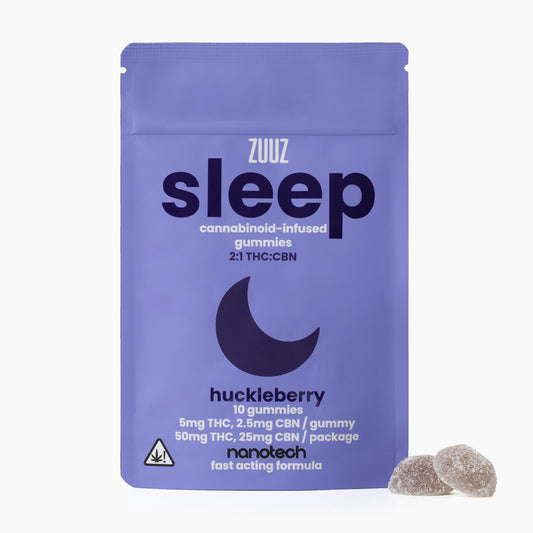
If you do choose an edible, look for third-party lab testing and clear dosing. ZUUZ makes sugar-free sleep gummies using a nanotech extraction method for faster, smoother, more consistent effects. Our sleep gummies are lab tested and backed by a 60-day money-back guarantee.

Frequently Asked Questions
Is it bad to take THC every night for sleep?
Daily THC use for sleep can lead to tolerance, meaning you may need higher doses over time for the same effect. Some people also experience rebound insomnia when they stop, where sleep gets worse before it improves. Research on long-term efficacy is limited, so nightly use is generally not recommended without medical supervision. If you find yourself increasing your dose regularly or struggling to sleep without THC, talk to a healthcare provider about alternatives.
Can THC help you fall asleep faster?
Some preliminary research suggests THC may reduce sleep onset latency, the time it takes to fall asleep. However, study quality varies, and individual response differs widely. THC may help with falling asleep in the short term, but it can also disrupt sleep continuity later in the night. If you want to try it, start with a low dose and track how you feel the next morning, not just how quickly you drifted off.
How long do THC edibles take to affect sleep?
Edibles typically take 30 minutes to 2 hours to kick in, depending on your metabolism, whether you ate recently, and the product's formulation. Effects can last 4 to 8 hours, which means timing matters if you want to avoid waking up groggy. Some products use advanced delivery methods like nanotech extraction to speed up absorption and create more consistent effects. Take edibles at least an hour before bed and start with a low dose.
Can THC use make sleep worse over time?
Yes, for some people. Regular use can lead to tolerance, so the same dose stops working as well. When you stop, rebound insomnia and withdrawal symptoms like irritability and vivid dreams can make sleep worse before it gets better. THC also suppresses REM sleep, which may affect memory and emotional processing. If sleep difficulties persist after stopping, or if you rely on THC nightly, a doctor or sleep specialist can help you find evidence-based care.
Insomnia is stubborn, and a sleep aid that works one night can fail the next. If you want a consistent, lab-tested option made to help you wind down without harsh comedowns, ZUUZ is worth trying. Our edibles use nanotech extraction for reliable effects, come in sugar-free options, and are covered by a 60-day money-back guarantee. Get started with ZUUZ and find a calmer path to better sleep.