
7 Ways to Find High Potency Mushroom Gummies in 2026
Last Updated: November 5, 2026
Quick Summary
To find high potency mushroom gummies, read the full ingredient list and a batch-specific certificate of analysis before you trust any milligram count. A blend weight like 1,500 mg only tells you total mass, not active compounds, so verify species, extract type, and lab results for your exact batch.
- A 2025 analysis by M. S. Correia found gummy labeling was overall inaccurate, with some products holding other substances.
- A 500 mg label figure only tells you the blend weighs 500 mg, not the active compound amount.
- Match the COA batch number to your package and treat a report within the last 12 months as current.
- A result reading below the limit of quantification means the compound may be present below the lab's threshold.
- The CDC's 2024 report described five people who needed hospital evaluation after eating nootropic gummies labeled as containing Amanita muscaria.
Table of Contents
- Start With the Ingredient List, Not the Milligram Count
- Match Mushroom Gummy Potency and Dosage to Your Goal
- Read Third-Party Lab Testing for Mushroom Gummies Before You Buy
- Extra Strength Mushroom Gummies Review: What the Label Won't Tell You
- Check the Product Category and Legal Status First
- Know the Safety Warnings Before You Increase Your Dose
- How to Find High Potency Mushroom Gummies You Can Actually Trust
- Frequently Asked Questions
Start With the Ingredient List, Not the Milligram Count
Learning how to find high potency mushroom gummies starts with a hard truth: the biggest number on the label is often the least useful one. A 2025 analysis by M. S. Correia and colleagues found that labeling on the psychoactive mushroom gummies tested was overall inaccurate, and some products suggesting Amanita muscaria content held other substances instead.
A mushroom gummy is a chewable supplement carrying mushroom extract, and sometimes botanicals, in a gummy base. The label should tell you what is inside and how much.
Here is what to check first:
- The full ingredient list, not just the front label
- The species name, such as reishi or Amanita muscaria
- The extract type and strength where listed
If a brand hides the ingredient list behind a "proprietary blend," treat that as a warning sign. You cannot judge potency from a name you cannot see.
Blend Weight vs. Active Compounds
A blend weight is the total mass of everything in the mushroom blend. It is not the same as the amount of active compounds.
A product listing for one brand states 1,500 mg of a mushroom blend per gummy, according to the seller's product page. That number tells you the blend weighs 1,500 mg. It does not tell you how much of any single compound is present.
So when you compare labels, ask three questions:
- Is this the blend total or a single extract amount?
- Which mushroom species make up the blend?
- Does a lab report confirm what the label claims?
Species and Extract Types to Look For
Different species do different things, so match the species to your goal before you worry about strength.
Extract type matters too. A concentrated extract packs more mushroom material into each gummy than a plain powder, and extraction method affects how clean the final product is. Ask whether the brand uses water or alcohol extraction, and whether it publishes that detail.
Match Mushroom Gummy Potency and Dosage to Your Goal
Mushroom gummy potency and dosage should match the effect you want, not the biggest number on the shelf. Start with one gummy, read the suggested use, and give it time before adding more.
For reference, the label on our chill. reishi gummies suggests one to two gummies daily. For a deeper walkthrough, see our guide on how to choose the right mushroom gummy dosage.
A few habits keep dosing sensible:
- Follow the suggested use on the package
- Note the dose per gummy before you buy
- Keep a simple log of what you took and how you felt
Why 500 mg on a Label Proves Very Little
A 500 mg figure only tells you the blend weighs 500 mg, nothing about active compounds or species identity.
This is the most common mistake we see: shoppers rank products by milligram count and skip the panel that matters. A smaller, verified dose beats a giant, unverified one every time.
Read Third-Party Lab Testing for Mushroom Gummies Before You Buy
Third-party lab testing for mushroom gummies helps check what a product contains, and a certificate of analysis (COA) is the report that documents it.
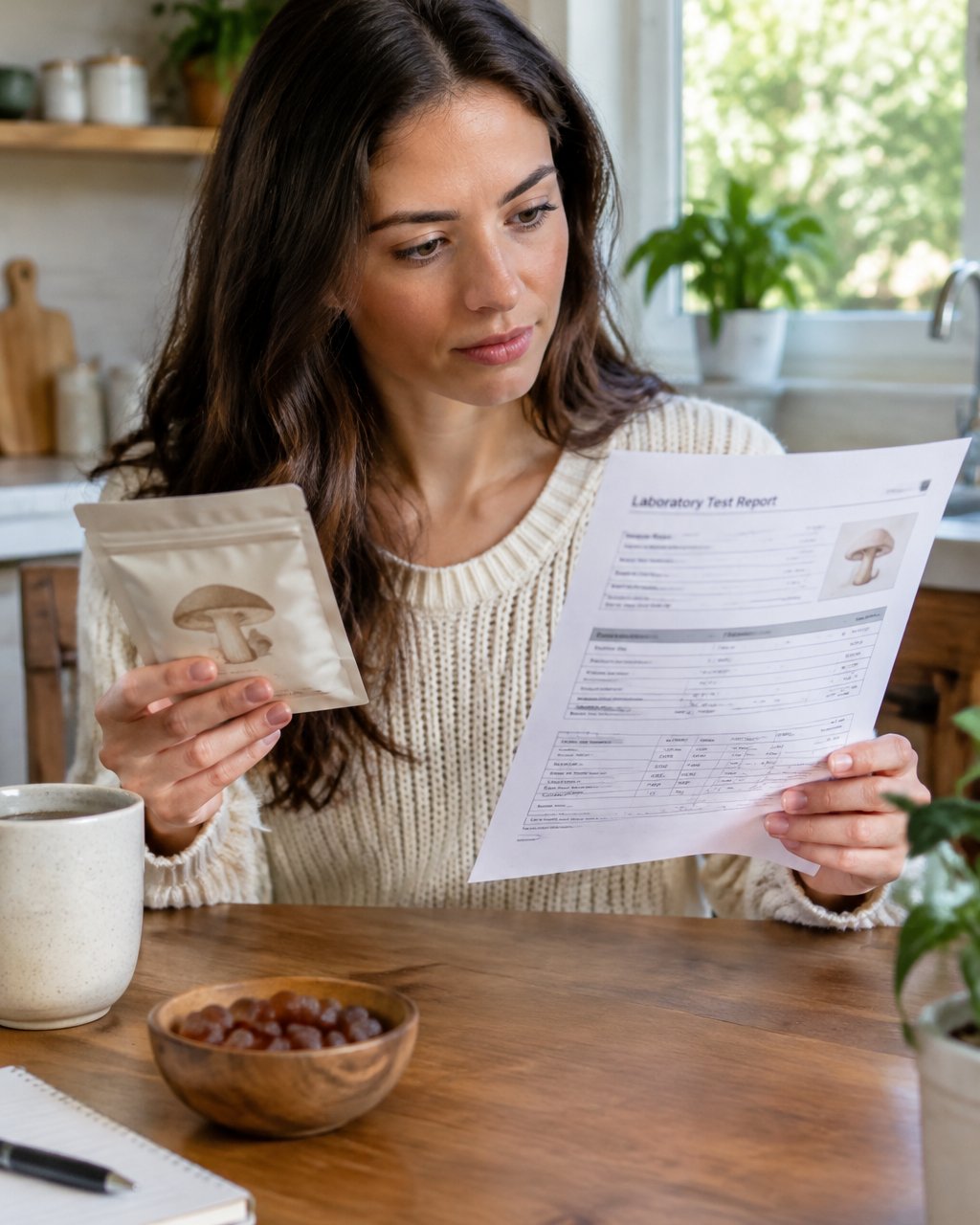
A COA is a report from an independent lab listing what it found in a sample.
Our own certificates are published for review, so you can see the format we mean. You can browse our certificates of analysis to compare against any label.
How to Read a Certificate of Analysis, Step by Step
A COA is only useful if you can verify four things: that it matches your batch, that it tested the right compounds, that the numbers are above the lab's detection limit, and that it screened for contaminants. Work through it in this order.
- Match the batch number. Find the lot or batch code on the package (often on the bottom or side of the tub) and confirm it matches the COA exactly. A missing or mismatched batch number is not evidence for your product.
- Check the test date. A COA should carry a collection or receipt date and a report date. A report older than the current batch is a mismatch. Most practitioners treat a COA within the last 12 months as current; anything older is a prompt to ask for a fresh report.
- Confirm the lab is independent. The report should name the laboratory and show an accreditation or license number where the state requires one. An in-house report is not third-party testing, no matter what the label says.
- Read the compound-by-compound results. A useful COA lists each target compound separately, specific triterpenoids or other marker compounds for the species, with a measured amount and unit. "Mushroom blend: present" tells you nothing about strength.
- Look for the limit of quantification (LOQ). The LOQ is the smallest amount the lab can reliably measure. A result reading "< LOQ" or "not detected" means the compound may be present below the lab's threshold, not the same as absent, and not proof of potency.
- Check the contaminant panel. Heavy metals (lead, arsenic, cadmium, mercury), microbial counts (total plate count, yeast and mold, E. coli, Salmonella), and pesticide or solvent residues belong on the report. A COA that only tests identity is a partial report.
- Compare the measured amount to the label claim. If the label says 200 mg of reishi extract per gummy, the COA's measured amount should be in the same range. A large gap either way is a reason to ask the brand for an explanation before you buy.
Watch out: a COA that lists only "mushroom blend" with no compound breakdown, no batch number, or no test date is a marketing PDF, not a lab report, treat it as no evidence at all.
What a Certificate of Analysis Should Show
A complete COA for a mushroom gummy typically includes the batch number, collection and report dates, laboratory name, compounds tested with measured amounts and units, and contaminant screening results. A complete COA makes it easier to compare batches on evidence rather than claims, a useful habit when you choose high quality supplements.
Check these items before you trust a potency claim:
- Batch number that matches your package
- Collection date and report date
- Name of the independent lab and its accreditation
A COA is not a strength score but a verification document. The label tells you what the brand claims; the COA tells you what the lab measured in a specific batch. When the two line up, you have something you can compare across products.
Extra Strength Mushroom Gummies Review: What the Label Won't Tell You
An extra strength mushroom gummies review should test the label against the lab report, not just repeat the marketing.
The chill. gummies list each active on the panel: reishi extract at 200 mg, plus L-theanine, lemon balm, passion flower, and valerian root at 25 mg each.
When you read a review, check whether it covers:
- The full ingredient list with amounts
- The species and extract type
- The COA and batch number
If a review skips the panel and the lab report, it is an ad, not a review.
Check the Product Category and Legal Status First
Legal status decides whether a product is a supplement, a food, or something else entirely, and that changes what testing you should expect. Before you compare potency, confirm the category, the label, not the marketing, establishes it.
Mushroom gummies land in different buckets, and the bucket determines the rules:
- Dietary supplements. These carry a Supplement Facts panel and are regulated as supplements. The panel lists serving size, ingredients, and amounts per serving. It does not certify potency, purity, or that the product works.
- Conventional foods. Some gummies are sold as snacks or confections with a Nutrition Facts panel. A food label is not a potency claim, and a food product is not held to supplement labeling rules.
- State-legal mushroom edibles. Some products are sold under state-level rules that vary widely. What is legal in one state may be restricted in another, and shipping rules differ by seller.
How to Verify the Category From the Label
You can usually place a product in a category by reading the package, not the product page. Check these items in order:
- Which facts panel is present? A Supplement Facts panel points to a dietary supplement; a Nutrition Facts panel points to a conventional food. No facts panel at all is a red flag.
- What does the species line say? A functional species such as reishi, lion's mane, or cordyceps is a different product category from Amanita muscaria. If the species is not named, you cannot verify the category.
- Does the package carry age limits? Age restrictions (18+ or 21+) signal that the seller is placing the product outside ordinary supplement rules.
- Where is it sold? Online, smoke shop, and convenience store channels carry different products and different levels of label scrutiny. A product sold only through one channel is worth a closer look.
- Does the seller state shipping restrictions? Sellers that ship only to certain states are signaling state-level rules apply. Confirm the current status with your state's health department before you order.
Watch out: a product marketed with psychedelic-style language but labeled as a dietary supplement is a category mismatch, the marketing and the label are telling you two different things, and you should not assume either one is accurate.
What the Label Does and Does Not Establish
A Supplement Facts panel establishes the serving size, ingredients, and amounts the brand claims per serving. It does not establish that those amounts were measured, that the species is correctly identified, or that the product is free of contaminants, those are COA questions, covered above.
A category check and a COA check work together. The category tells you which rules apply and what testing to expect; the COA tells you whether the specific batch matches the label.
Know the Safety Warnings Before You Increase Your Dose
Safety comes before strength, every time. The CDC's 2024 report described five people who needed hospital evaluation after eating nootropic gummies labeled as containing Amanita muscaria.
Experts at UVA Health analyzed brain-health gummies after those five people, including a 3-year-old child, became sick. The lesson is simple: keep these products out of reach of children and pets.
Watch out: mixing mushroom gummies with alcohol, sleep aids, or other sedatives can compound effects. If you take prescription medication, ask a pharmacist before you start.
Skip mushroom gummies entirely if you are pregnant, nursing, under 18, or managing a medical condition without your doctor's sign-off.
How to Find High Potency Mushroom Gummies You Can Actually Trust
To find high potency mushroom gummies you can trust, use a repeatable check instead of a gut feeling. Run every product through the same short list.
| Step | What to Check | Why It Matters |
|---|---|---|
| 1 | Full ingredient list | Shows what is actually inside |
| 2 | Species and extract type | Tells you the intended effect |
| 3 | Blend weight vs. active amounts | Separates mass from strength |
| 4 | Batch-specific COA | Confirms label claims |
| 5 | Category and legal status | Tells you the rules that apply |
| 6 | Safety warnings and age limits | Protects you and your household |
For more help matching a product to your goal, read our guide on how to choose mushroom gummies for relaxation, or browse the full supplement collection to see lab-tested options.
Frequently Asked Questions
Is a 500 mg mushroom gummy strong?
Not necessarily. That 500 mg usually describes the total mushroom blend or extract weight, not the amount of any single active compound. A 500 mg gummy built mostly from bulking agents can deliver less than a 200 mg gummy made with a concentrated extract. The only way to know what you are getting is to read the certificate of analysis and confirm the lab measured the specific compounds the label claims, not just the total powder weight.
How can you verify the potency of mushroom gummies?
Ask for the batch certificate of analysis and check three things: that the lab is independent of the brand, that the report lists the same compounds named on the label, and that the batch number matches the package you are holding. Labels on some psychoactive mushroom gummies may not match their contents. A COA tied to your specific batch is the only reliable check.
Are mushroom gummies with different active ingredients comparable by milligrams?
No. Reishi, lion's mane, and Amanita muscaria work through entirely different compounds, so comparing them by milligram is like comparing caffeine to melatonin by weight. Functional mushroom gummies, such as reishi blends with L-theanine and lemon balm, are dosed for relaxation support, while psychoactive products carry different risks altogether. Compare products within the same category and the same named compound, never across categories.
What safety concerns should you check before trying mushroom gummies?
First confirm which category the product belongs to, since psychoactive gummies and functional mushroom gummies carry very different risk profiles. Some people have required hospital evaluation after ingesting gummies labeled as containing Amanita muscaria. Check for a batch COA, avoid products with vague blend labels, and talk to a physician before use if you are pregnant, nursing, under 18, or taking medication.
The hardest part of buying mushroom gummies is trusting the label. We built ZUUZ around that problem, with science-backed, third-party lab tested formulas and a nanotech extraction method for faster, smoother absorption. Our sugar-free tart options and 60-day money-back guarantee make it easy to try without risk. Get started with ZUUZ and find a gummy you can actually trust.