
Do the Benefits of CBN for Sleep Cycles Hold Up?
Last Updated: October 29, 2026
Quick Summary
CBN for sleep has its strongest evidence for sleep maintenance, not sleep stages: a 2024 randomized, double-blind, placebo-controlled trial found 20 mg of CBN produced fewer nighttime awakenings and less sleep disturbance than placebo. Evidence on REM and deep sleep remains thin, and no optimal dose is established, so start low and check for a batch-specific COA.
- CBN forms when THC degrades and oxidizes, and it binds weakly to CB1 receptors compared with THC.
- A normal sleep cycle lasts roughly 90 to 110 minutes and moves through N1, N2, N3, and REM stages.
- A 2023 dose-ranging study examined 30 mg and 300 mg and suggested reduced wake after sleep onset.
- Start at 5 mg or less, then increase by 5 mg increments with at least two nights between changes.
- Trouble sleeping three or more nights a week for three months or longer warrants evaluation, with CBT-I as first-line treatment.
Table of Contents
- What CBN Is and How It Differs From CBD and THC
- What a CBN Sleep Study Actually Measures
- CBN and REM Sleep: What the Stage-by-Stage Evidence Shows
- Nighttime Awakenings and Sleep Maintenance
- How Long Does CBN Take to Work and How Long Do Effects Last?
- CBN Side Effects, Interactions, and Higher-Risk Groups
- Dosing and Product Variability: What the Labels Don't Tell You
- Choosing a CBN or THC Product for Sleep
- Frequently Asked Questions
What CBN Is and How It Differs From CBD and THC
CBN is a minor cannabinoid that forms when THC degrades and oxidizes over time. It is not CBD and not THC, though it shares chemical ancestry with both.
CBD is non-intoxicating and interacts with the endocannabinoid system indirectly. THC binds directly to CB1 receptors and produces the high. CBN sits somewhere in between in popular imagination and nowhere near that simple in the lab.
Where CBN Sits Among the Cannabinoids
Cannabinol is a mildly psychoactive degradation product of THC, typically present in aged cannabis at low concentrations. It binds weakly to CB1 receptors compared with THC.
That weak binding is exactly why researchers are cautious. The Sleep Foundation's overview of CBN research notes there is not enough high-quality research to determine whether CBN improves sleep, and older studies found little effect.
What a CBN Sleep Study Actually Measures
Most CBN sleep studies measure self-reported sleep quality, not sleep architecture. That is the single most important thing to understand before you read any headline about CBN and sleep stages.
A 2024 randomized, double-blind, placebo-controlled trial found that 20 mg of CBN was associated with fewer nighttime awakenings and less overall sleep disturbance than placebo, according to Bonn-Miller et al. in PubMed.
Clinical Findings vs. Anecdotal Claims
Clinical evidence and anecdotal claims diverge sharply here. A 2023 study examining 30 mg and 300 mg doses reported results suggesting CBN could reduce wake after sleep onset, per Lavender et al. in PubMed Central, but the same summary cites a review finding insufficient evidence to support sleep-related claims.
| Evidence Type | What It Shows | What It Does Not Show |
|---|---|---|
| Randomized trial | Fewer awakenings at 20 mg | Improved sleep stages |
| Dose-ranging study | Reduced wake after sleep onset | Consistent effect size |
| Anecdotal reports | Users feel relaxed | Causation or mechanism |
| Narrative reviews | Insufficient evidence | Any confirmed benefit |
The pattern is clear: measurable effects on sleep maintenance, thin evidence on sleep architecture.
CBN and REM Sleep: What the Stage-by-Stage Evidence Shows
Stage-specific claims about CBN and REM sleep outrun the data, and the fastest way to see why is to understand what a sleep cycle actually is before you read any headline about a cannabinoid "restoring deep sleep."
Sleep Architecture in Brief
A normal night is not one continuous state. It is a series of cycles, each lasting roughly 90 to 110 minutes in adults, and each cycle moves through distinct stages:
- NREM stage 1 (N1): the light transition from wake to sleep, lasting only a few minutes.
- NREM stage 2 (N2): the bulk of adult sleep, marked by sleep spindles and K-complexes; this is where the body consolidates much of its light-to-moderate sleep.
- NREM stage 3 (N3): slow-wave or deep sleep, concentrated in the first half of the night and associated with physical restoration.
A typical adult spends roughly 45 to 55 percent of the night in N2, 15 to 25 percent in N3, and 20 to 25 percent in REM, with wide variation by age. "Better sleep" is not one number, it is a pattern of stage transitions, cycle length, and total time asleep, and most consumer CBN claims collapse all of that into a single vague promise.
What Objective Measurement Actually Tracks
When researchers say they measured sleep objectively, they usually mean polysomnography (PSG), electrodes recording brain waves (EEG), eye movements (EOG), and muscle tone (EMG), or a wearable-derived estimate.
That distinction matters because a study can show a real change in one measure, say, fewer awakenings, while showing no meaningful change in stage distribution. Those are different claims and should be reported differently.
What the Stage-Specific Evidence Shows
The most cited objective study comes from University of Sydney researchers, who reported that CBN increased both NREM and REM sleep and total sleep time in an objective measurement study, per the University of Sydney news release.
"CBN was found to increase both NREM and REM sleep, leading to increased total sleep time, with a comparable effect to ..." -- Professor Arnold at The University of Sydney (University of Sydney news release, 2024)
Read that carefully. A separate 2024 randomized, double-blind, placebo-controlled trial of 20 mg CBN found fewer nighttime awakenings and less overall sleep disturbance than placebo, per Bonn-Miller et al. in PubMed, a sleep-maintenance signal, not a stage-architecture result. A 2023 dose-ranging study of 30 mg and 300 mg reported results suggesting reduced wake after sleep onset, per Lavender et al. in PubMed Central, while the same summary cites a review finding insufficient evidence to support broad sleep claims.
Why Stage Claims Are Hard to Prove
Three problems keep stage-specific claims unsettled. Most CBN sleep research relies on self-report or wearables rather than laboratory PSG, so stage-level conclusions are estimates on top of estimates. Sample sizes in cannabinoid sleep trials tend to be small, and effects that look meaningful in a small sample often shrink in a larger one. And CBN products vary in potency and formulation, so a study using a measured 20 mg dose may not translate to a retail product whose label is inaccurate.
Bring that frame to every headline: ask what was measured (self-report, wearable, or PSG), in how many people, at what measured dose, and for how many nights. If a claim about REM or deep sleep cannot answer those four questions, treat it as marketing rather than evidence.
Nighttime Awakenings and Sleep Maintenance
Sleep maintenance is where CBN has its strongest, if still limited, case. Calming the nervous system through a nightly ritual like herbal tea for sleep often complements these pharmacological interventions by reinforcing the body's natural transition into a deeper, more sustained rest.
If that is your pattern, CBN is a more rational candidate than if your problem is sleep onset latency. For broader natural strategies that work alongside any cannabinoid, our guide to 5 ways to improve sleep quality naturally covers the behavioral basics worth locking in first.
Watch out: treating a maintenance problem with a sleep-onset solution wastes money and time. Match the compound to the symptom.
How Long Does CBN Take to Work and How Long Do Effects Last?
Onset depends almost entirely on delivery format, not the cannabinoid itself. Inhaled CBN reaches the bloodstream in minutes.
That variability is why timing matters more than dose for many people. Take an edible too late and you wake up groggy. If onset speed is your priority, fast-acting edibles for sleep are worth understanding before you buy.
CBN Side Effects, Interactions, and Higher-Risk Groups
CBN's side effect profile is generally described as mild, but "mild" is not "none." Reported issues include drowsiness, grogginess, and next-day effects, particularly at higher doses.
Higher-risk groups deserve specific mention. A 2026 UConn study reported that repeated CBN exposure produced signs of physical dependence in mice, per UConn Today's report on CBN dependence research.
Our own position on cannabinoid safety and efficacy is laid out in why we believe cannabinoids are safe and effective for sleep, including where the evidence is strong and where it is not.
Dosing and Product Variability: What the Labels Don't Tell You
There is no established optimal dose of CBN for sleep. That single sentence should govern how you read every dosing recommendation, including the ones below. What exists is a small set of studied doses, a large and loosely regulated retail market, and a lot of individual variation.
What the Studies Actually Used
The clinical literature clusters around a few measured doses. The 2024 randomized, double-blind, placebo-controlled trial used 20 mg of CBN and found fewer nighttime awakenings and less overall sleep disturbance than placebo, per Bonn-Miller et al. in PubMed. A 2023 dose-ranging study examined 30 mg and 300 mg and reported results suggesting reduced wake after sleep onset, per Lavender et al. in PubMed Central.
What the studies do not establish is a dose-response curve you can follow at home. A finding at 20 mg does not mean 40 mg is twice as good, and the 300 mg arm does not mean high doses are safer or more effective, higher doses are also where next-day grogginess and other side effects tend to concentrate.
Why Retail Labels Rarely Match Study Doses
A product claiming 20 mg of CBN may contain more or less than that amount. Without a batch-specific certificate of analysis (COA) from an independent lab, you have no way to know what you are taking.
Formulation adds a second layer of variability. An isolate powder, a full-spectrum oil, a nano-emulsified tincture, and a gummy are not interchangeable even at the same labeled milligram count.
A Practical, Evidence-Aware Approach
Because no optimal dose is established, the sensible approach is conservative titration with careful record-keeping:
- Start low. 5 mg or less is a reasonable starting point for people new to cannabinoids, well below the 20 mg studied dose.
- Change one variable at a time. Increase by 5 mg increments, waiting at least two nights between changes so you can attribute any effect.
- Log the right outcomes. Record dose, time taken, time to sleep, number and timing of awakenings, and morning grogginess. Self-reported sleep quality is useful, but it is not the same as measured sleep duration or awakenings.
When to Stop Self-Experimenting and Seek Evaluation
A cannabinoid supplement is a poor first-line tool for persistent insomnia.
Red flags that should prompt a clinician conversation rather than a purchase: loud snoring or witnessed pauses in breathing (possible sleep apnea), irresistible daytime sleepiness, restless legs, sleepwalking or other parasomnias, and any sleep problem that began alongside a new medication.
For the behavioral basics that work alongside any cannabinoid, our guide to 5 ways to improve sleep quality naturally covers the foundation worth locking in first, and lab testing for edibles and why it matters explains how to read a COA before you buy.
Choosing a CBN or THC Product for Sleep
Product choice comes down to three variables: cannabinoid ratio, delivery format, and testing transparency. A CBN-only product suits people who want to avoid THC entirely. A CBN plus THC combination leans on THC's stronger sedating effect, which is better supported for sleep onset but carries intoxication risk.
| Option | Best For | Watch Out For |
|---|---|---|
| CBN isolate | THC-averse users | Weak standalone evidence |
| CBN + CBD | Balanced, non-intoxicating | Slower onset |
| CBN + THC | Stubborn insomnia | Intoxication, grogginess |
| CBN + melatonin | Onset plus maintenance | Melatonin interactions |
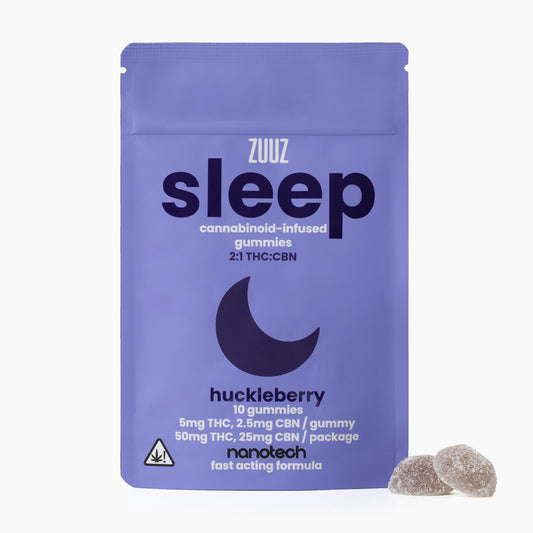
ZUUZ's sleep products are made with nanotech extraction, are third-party lab tested, and include sugar-free options. The 60-day money-back guarantee applies to ZUUZ purchases.
Frequently Asked Questions
Does CBN affect REM sleep?
The most direct human data comes from a 2024 University of Sydney study, which reported that CBN increased both NREM and REM sleep and total sleep time. That is a meaningful signal, but it is one study, and the 2024 randomized, placebo-controlled trial by Bonn-Miller and colleagues measured sleep disturbance and awakenings rather than sleep-stage architecture. The Sleep Foundation notes there is not yet enough high-quality research to say CBN reliably improves sleep. Treat stage-specific claims as promising rather than settled.
How long does CBN take to work for sleep, and how long do the effects last?
The research does not give a clean onset time for CBN specifically. The 2024 trial used 20 mg and the 2023 study tested 30 mg and 300 mg, but neither supplied results pin down how quickly effects begin. Edible and oil formats generally absorb more slowly than inhaled products. Effects typically run for several hours, which is why timing matters: take it 60 to 90 minutes before bed rather than right as you get in.
What are the CBN side effects to watch for?
Reported issues cluster around next-day grogginess, sleepiness that lingers past waking, and drug interactions. CBN can add to the sedating effect of alcohol, benzodiazepines, sleep prescriptions, and antihistamines, so combining them is risky. A 2026 UConn study found signs of physical dependence in mice after repeated CBN exposure, which is an early animal signal, not a human finding. Anyone pregnant, breastfeeding, on prescription medication, or managing a chronic condition should talk to a clinician first.
Is CBN better than CBD for sleep?
They work differently. CBD has broader research behind it but is not primarily sedating, while CBN is studied specifically for sleep maintenance and nighttime awakenings. The 2024 placebo-controlled trial found 20 mg of CBN reduced awakenings and overall sleep disturbance versus placebo. Many products combine the two. If your problem is falling asleep, the evidence base is thinner for both; if it is staying asleep, CBN has the more targeted data, though the Sleep Foundation still calls the overall evidence insufficient.
The honest takeaway is this: CBN shows real promise for sleep maintenance and nighttime awakenings, and the evidence for stage-specific benefits like deep sleep or REM enhancement is not there yet. If you want a sleep product built for consistency rather than hype, get started with ZUUZ and see how a lab-tested, fast-acting edible fits your routine.