
How to Choose Sugar-Free THC Tarts for Diabetics
Table of Contents
- Start With Your Blood Sugar Goals
- How to Read a THC Tart Label for Sugar and Carbs
- Sugar-Free Cannabis Sweeteners: What Is Actually Inside
- THC Edibles and Blood Sugar: What the Research Says
- How Long THC Edibles Take to Work and Why Dose Matters
- Sugar-Free THC Edibles for Diabetics: Safety and Testing
- Conclusion
- Frequently Asked Questions
Last Updated: October 14, 2026
Start With Your Blood Sugar Goals
Choosing sugar-free THC tarts for diabetics starts with one question: what do you need these sugar-free thc tarts to do for your body?
At ZUUZ, we hear from customers who want calm, sleep, or a mood lift without a glucose spike. That goal is reasonable.
Here is what matters most before you buy:
- Your target dose. Know how many milligrams of THC you want per serving.
- Your carb budget. A tart still carries carbohydrates, even without added sugar.
- Your timing. Edibles take a while to kick in, so plan around meals and sleep.
- Your testing standard. Look for third-party lab results, not marketing claims.
The American Diabetes Association guidance on carbohydrate counting treats total carbohydrates as the number that affects blood glucose most.
How to Read a THC Tart Label for Sugar and Carbs
A THC tart label tells you three things that matter: serving size, total carbohydrates, and THC content per piece. Read all three before you eat anything.
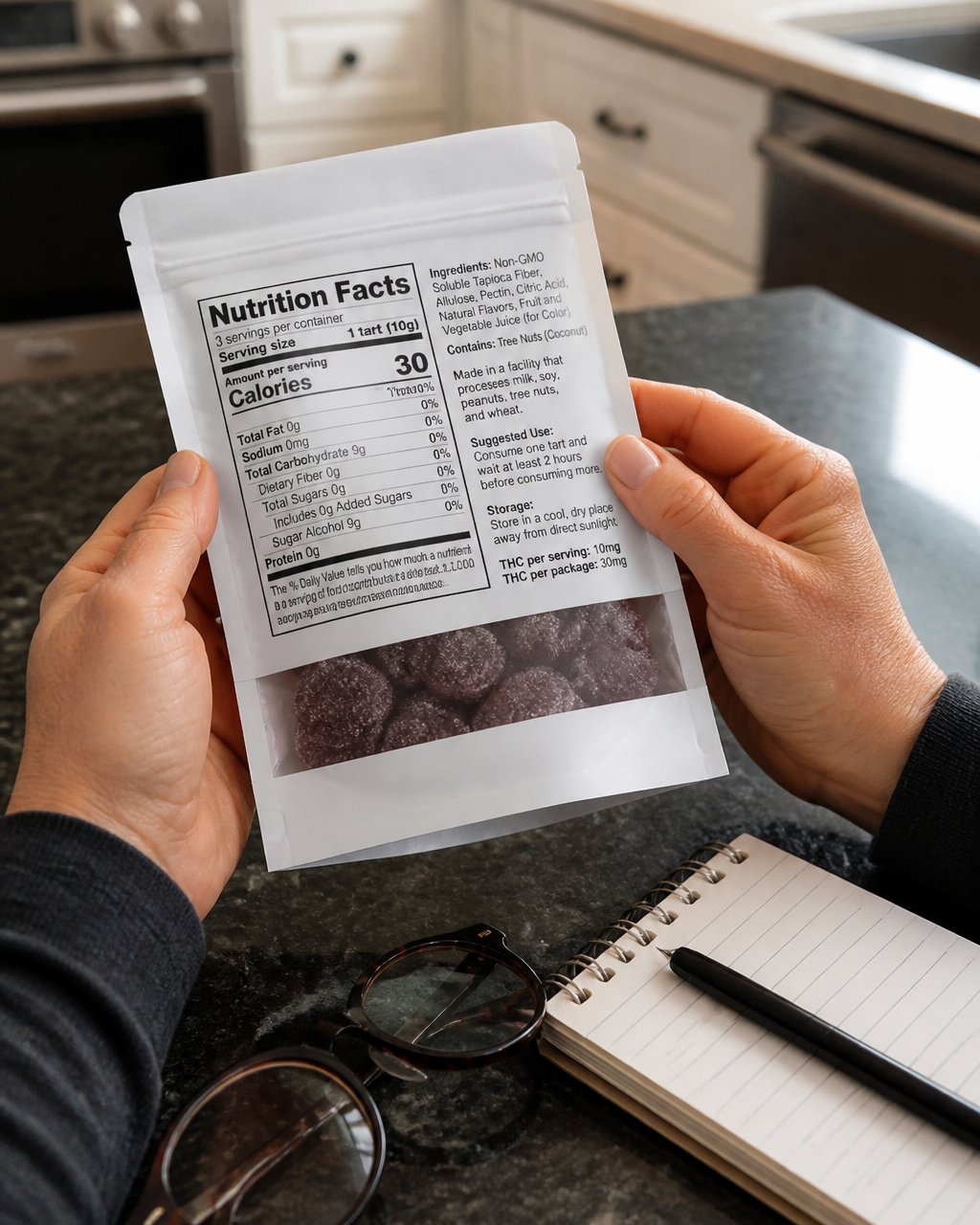
Start with the nutrition panel. Then check the THC panel. Then do the math on how much you actually plan to eat.
Use this checklist:
- Serving size: Is one tart one serving, or is it half? Many tarts are sold as two-bite pieces, and the panel may list half a tart as one serving.
- Total carbohydrates: Note the grams per serving, then multiply by how many servings you actually eat.
- Dietary fiber: Subtract it from total carbs if you are counting net carbs, since fiber is not digested as glucose.
- Added sugars: Should read zero on a sugar-free product.
- Sugar alcohols: Listed separately, often under total carbs. Subtract them only if you know how your body responds to that specific sweetener.
- THC per serving: Usually in milligrams. Confirm whether the number is per tart or per package.
- Batch or lot number: Needed to match lab results.
The tart-specific math most guides skip
A tart is not a gummy. It has three parts that each carry carbohydrates: the crust, the filling, and any glaze or drizzle. A sugar-free tart can still land at 12-20 grams of total carbohydrate per piece once you add up flour, nut meal, dairy, and sugar alcohols.
Worked example using a typical label pattern (numbers vary by product, always read your own package):
- Total carbohydrates per serving: 15 g
- Dietary fiber: 4 g
- Sugar alcohols: 6 g
- Added sugars: 0 g
- Net carbs (total minus fiber minus sugar alcohols): 5 g
That 5 g net carb figure is the number many people with diabetes track, but it is not a guarantee. Sugar alcohols like maltitol are partially absorbed and can still move blood glucose.
Crust and filling checks
- Crust: Almond flour and coconut flour crusts run lower in carbohydrate than wheat-flour crusts. Ask or check the ingredient list for the first flour listed.
- Filling: Fruit-based fillings add naturally occurring sugar even when no sugar is added. Look for the fruit's position on the ingredient list.
- Glaze: A sugar-free glaze may still use maltitol or isomalt. Check the sweetener name, not just the "sugar-free" claim.
- Chocolate coating: Sugar-free chocolate often uses erythritol plus inulin or soluble corn fiber, both of which count toward total carbs.
A common mistake is assuming a small tart means a small dose. Some tarts pack a full serving of THC into a single bite. Others expect you to split one piece. If the package says "10 mg THC per tart" and "2 servings per tart," you are looking at 5 mg per serving, a meaningful difference for a first-time user.
If you are coming from gummies, expect tarts to feel denser and sometimes sweeter in texture. That texture often comes from sugar alcohols, which we cover next.
Sugar-Free Cannabis Sweeteners: What Is Actually Inside
Sugar-free cannabis sweeteners replace sugar with ingredients like erythritol, maltitol, stevia, and other sugar alcohols. Each one behaves differently in your body.
Sugar alcohols are carbohydrates that taste sweet but absorb slowly. Common ones in edibles include:
- Erythritol: Low glycemic impact, but can cause stomach upset in large amounts.
- Maltitol: Sweeter, but more likely to raise blood glucose and cause gas.
- Xylitol: Popular in sugar-free desserts, moderate glycemic impact.
- Stevia: Plant-based, no carbs, but a distinct aftertaste.
- Allulose: Rare sugar with minimal effect on blood glucose.
The FDA guidance on sugar alcohols and carbohydrate labeling explains that sugar alcohols still count toward total carbohydrates, even when they are not "sugar." That is why the total carb line matters more than the sugar line.
For sugar-free THC edibles for diabetics, erythritol and allulose tend to be gentler choices. Maltitol is the one to watch if you are sensitive.
Maltitol can cause bloating and gas in some people, and it still affects blood glucose. If a tart lists maltitol first, treat it as a higher-carb option.
THC Edibles and Blood Sugar: What the Research Says
THC edibles and blood sugar is a topic with more questions than firm answers.
What we can say with confidence:
- THC does not contain sugar, so the drug itself is not a carb source.
- The carrier ingredients in an edible are what affect blood glucose.
- Sugar alcohols and fiber change how fast carbs absorb.
- Alcohol and THC together can complicate blood sugar control.
The CDC information on cannabis and health notes that cannabis effects differ by person, dose, and product.
If you take insulin or other glucose-lowering medication, talk to your doctor before adding any edible to your routine.
A practical approach: test your blood glucose before, and again a couple of hours after, your first tart.
How Long THC Edibles Take to Work and Why Dose Matters
How long THC edibles take to work depends on the product, but most take 30 minutes to two hours to peak.
Here is why. People eat a tart, feel nothing after 20 minutes, eat another, and then both hit at once. The result is too much THC, too fast.
Dose rules that keep this from happening:
- Start low. Beginners should begin with a small fraction of a standard serving.
- Wait the full window. Give it at least two hours before deciding it did not work.
- Do not stack doses. One tart, then wait.
- Track your response. Write down dose, time, and how you felt.
- Keep it consistent. Same product, same dose, same conditions.
Nanotech extraction, the method we use at ZUUZ, is designed to speed up and smooth out absorption.
Sugar-Free THC Edibles for Diabetics: Safety and Testing
Sugar-free THC edibles for diabetics should come with proof, not promises. Third-party lab testing is the clearest sign a product is what it claims to be, but only if you know how to verify it.
What to look for on a certificate of analysis (COA):
| Check | What It Confirms | Why It Matters for a Tart |
|---|---|---|
| Cannabinoid profile | Actual THC and CBD amounts | Confirms the mg per tart matches the label, so your dose math holds |
| Pesticide screen | No harmful residues | Cannabis concentrates can carry residues; tarts use infused filling |
| Heavy metals test | No lead, arsenic, or mercury | Relevant for cocoa, nut flours, and fruit fillings |
| Microbial test | No mold or bacteria | Baked and filled products are more perishable than gummies |
| Solvent residue | Clean extraction | Matters if the tart uses distillate or infused oil |
| Water activity / stability | Product safety over shelf life | Tarts with fruit filling can spoil faster than dry edibles |
Anyone can claim lab testing. The proof is a batch number that matches a real COA you can view. On a tart package, look for a lot code printed near the expiration date, then match it to the COA on the brand's website or a QR code on the label.
Diabetes-specific safety framing
Sugar-free does not automatically mean suitable for every person with diabetes. Three reasons:
- Sugar alcohols still affect some people's glucose. Maltitol and sorbitol are partially absorbed and can raise blood glucose, especially in larger amounts. Erythritol and allulose have minimal effect for most people.
- Total carbohydrates still count. A tart can carry 12-20 g of carbohydrate per piece even with zero added sugar.
- THC itself can influence how you feel and eat. Some people notice increased appetite or changed perception of hunger cues after edibles, which can complicate carb budgeting.
If you take insulin or a glucose-lowering medication, talk with your clinician before adding any edible to your routine. Bring the product label and the COA to that conversation so the two of you can look at the actual numbers.
A practical first-tart protocol
- Test blood glucose before eating.
- Eat one serving, not one tart, if the label lists more than one serving per piece.
- Set a timer for two hours.
- Test blood glucose again at the two-hour mark and note the result alongside the dose, the sweetener type, and what you ate that day.
- Repeat with the same product and dose before trying anything new.
That personal log beats any general guideline, because edible responses vary widely by person, dose, and product.
A few more safety notes:
- Store tarts away from kids and pets, ideally in a locked container.
- Keep the package so you can check the label and lot code again.
- Do not mix edibles with alcohol on a first try.
- Tell someone you trust what you took and when.
- Discard tarts past their expiration date, the filling can spoil even if the THC remains stable.
Conclusion
Finding a tart that fits your blood sugar plan takes a little homework, but it is not complicated.
That is the standard we build ZUUZ around. Our sugar-free tarts use a nanotech extraction method for faster, smoother effects, and every batch is third-party lab tested so you know exactly what you are getting.
Get started with ZUUZ and find a sugar-free THC tart that fits your routine.
Frequently Asked Questions
Are sugar-free THC edibles safe for people with diabetes?
Sugar-free THC edibles can be part of a diabetes-friendly routine, but safety depends on the product and your individual health. Check the nutrition label for total carbohydrates and sugar alcohols like maltitol or erythritol, since these can still affect blood glucose. Start with a low dose, monitor your blood sugar, and talk to your healthcare provider before trying any THC product. Third-party lab testing is a must to confirm there are no unwanted additives.
What sweeteners are used in sugar-free THC tarts?
Common sugar-free cannabis sweeteners include erythritol, stevia, monk fruit, and maltitol. Erythritol and stevia have minimal impact on blood sugar, while maltitol can cause spikes and digestive discomfort in some people. Always read the ingredient list to see which sweetener is used. ZUUZ offers sugar-free tarts designed to keep sugar content low without sacrificing taste.
Can sugar-free edibles still affect blood glucose?
Yes, sugar-free edibles can still affect blood glucose. Sugar alcohols like maltitol have a glycemic impact, and other ingredients such as flour or fruit fillings add carbohydrates. THC itself may influence blood sugar regulation, though research is limited. Check total carbohydrates per serving, not just added sugars, and monitor your levels after trying a new edible to see how your body responds.
How long do THC tarts take to kick in?
THC edibles typically take 30 minutes to 2 hours to take effect, depending on the product and your metabolism. Tarts made with nanotech extraction, like ZUUZ, may work faster because the THC is absorbed more efficiently. Wait at least 2 hours before taking more to avoid overconsumption. Effects can last 4 to 6 hours, so plan accordingly and start with a low dose.